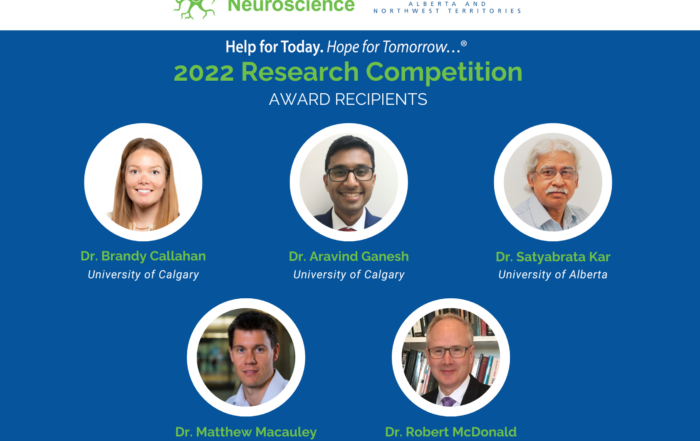
The first year of the Hope for Tomorrow Research Competition will see just over $1 million CAD in funding distributed to five outstanding Alzheimer’s and dementia research projects in Alberta, facilitated by a partnership between the Alzheimer Society of Alberta and Northwest Territories (AS AB/NT) and Campus Alberta Neuroscience (CAN).
July 28, 2025
2024 Hope for Tomorrow Research Competition Awards $1 Million to Alberta-Based Alzheimer’s Research Projects
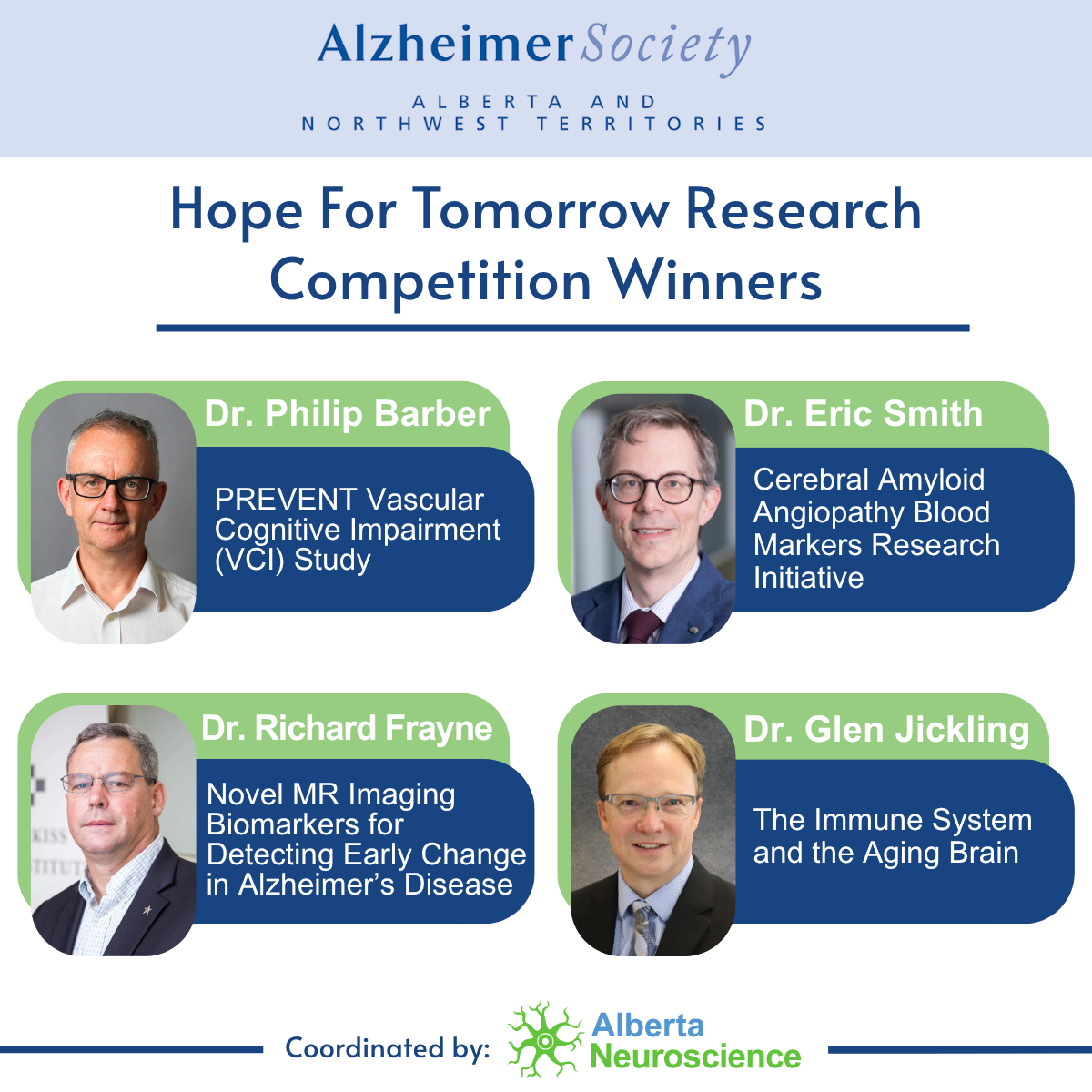
The Alzheimer Society of Alberta and Northwest Territories and Alberta Neuroscience are pleased to announce this year’s awardees.
The 2024 Hope for Tomorrow Research Competition will see over $1 million CAD in funding distributed to four outstanding Alzheimer’s and dementia research projects in Alberta, facilitated by a partnership between the Alzheimer Society of Alberta and Northwest Territories (AS AB/NT) and Alberta Neuroscience (ABNeuro).
Awardees
AS AB/NT and ABNeuro are pleased to announce the principal investigators and their projects funded by the Hope for Tomorrow Research Competition:
- Dr. Philip Barber – University of Calgary
PREVENT Vascular Cognitive Impairment (VCI) Study
The PREVENT VCI study detects early dementia risk by tracking Alzheimer’s blood markers in minor stroke patients. Using AI, it links amyloid-covered platelets to brain shrinkage and vessel damage, aiming to catch disease before symptoms begin.
Study Details
The onset of dementia is most related to the co-existence of Alzheimer’s disease (AD) and stroke burden, which contribute to early breakdown of the brain’s connecting networks that eventually leads to impaired brain function. Despite enormous effort, there is currently no cure for dementia. To have the best chance of halting dementia, we need to intervene much earlier, and therefore we need to detect these diseases at the very earliest stages before they can take hold and progress.
The PREVENT VCI study has recruited minor stroke patients and controls to identify those individuals at greatest risk of change in brain function. To achieve this aim we have developed a novel blood biomarker for AD by detecting the “sticky” toxic protein amyloid causing AD on blood platelets as they flow through the brain.
We aim to determine the effect of this “sticky” protein on platelets on the early progression of disease affecting the very smallest (micro) vessels that penetrate the brain. The small vessels are critical for supplying blood and essential nutrients to the brain so when they become diseased, they can affect the structure and function of the brain over time. We use artificial intelligence to explore how following a minor stroke AD blood markers change over time and how they affect the earliest signs of disease by measuring the rate at which the brain shrinks, the accumulation of disease affecting the small vessels, and the overall impact on brain function.
At the end of this study, we anticipate that blood derived markers of AD will be detected more frequently in minor stroke patients than controls allowing us to detect the earliest signs of brain shrinkage and small vessel disease that are recognized risks for dementia. This will be a major advance in our understanding of the relative contribution of two diseases, AD, and disease affecting the small vessels at the very earliest stage.
- Dr. Richard Frayne – University of Calgary
Novel MR Imaging Biomarkers for Detecting Early Change in Alzheimer’s Disease
We use advanced MRI to spot early brain changes linked to dementia. By comparing scans to our “Lifespan Charts” of normal aging, we aim to detect mild cognitive issues sooner—helping doctors intervene earlier and support healthy brain aging.
Study Details
Aging is a natural part of life that affects many things, including how we work, when we retire, how we interact with others, and how likely we are to develop long-term illnesses like dementia. As more people get older, it becomes more important to find ways to spot early signs of memory problems or dementia. Finding these signs early can help individuals and health systems prepare better and start treatment or lifestyle changes sooner.
One way to look for changes in the brain is by using magnetic resonance imaging, or MR imaging. A special kind of MR imaging, called quantitative MR (or qMR), can detect very small changes in brain tissue. These changes might not be seen using regular scans. qMR is also safe and can be repeated over time, making it a useful tool to track brain health as people age.
Our research team has already used qMR scans from healthy adults to create “Lifespan Charts.” These charts are similar to growth charts used for children. They show what typical brain changes look like across a person’s life. These charts can help doctors see if someone’s brain is aging normally or if there may be signs of a problem.
In this project, we will study people who have been diagnosed with mild cognitive impairment or dementia. We will compare their brain scans to our Lifespan Charts. This will help us find warning signs and set cut-off points for what’s normal and what’s not.
Our goal is to support healthy brain aging by helping doctors catch problems early. This could lead to better care, earlier treatment, and healthy changes to daily life for people at risk of dementia.
- Dr. Glen Jickling – University of Alberta
The Immune System and the Aging Brain
Aging damages small brain vessels, reducing resilience to diseases like Alzheimer’s. Our study explores how immune system changes contribute to this damage, aiming to find treatments that prevent cognitive decline and improve brain health.
Study Details
With advancing age the human brain accumulates disease of the small blood vessels. This small vessel disease decreases the brain’s resiliency to additional brain injury such as Alzheimer’s disease, Parkinson’s disease, and stroke. Small vessel disease is a major cause of memory impairment and dementia. This small vessel disease is potentially treatable, with the hope that treatment could help prevent vascular dementia and enable the brain to be more resilient to other causes of dementia. In this study we will determine how changes in our immune system that occur with age contribute to this small vessel disease and the associated cognitive decline. We will determine the relationship of the small vessel disease to activation of the immune system that promotes disruption of the blood vessel wall over time. This study has the potential to identify novel treatments targeting the immune system to decrease or even prevent the small vessel disease. It will provide the rationale and data needed to test specific agents that target the immune system to reduce the small vessel disease. The goal is the prevention of cognitive decline and overall improvement of brain health.
- Dr. Eric Smith – University of Calgary
Cerebral Amyloid Angiopathy Blood Markers Research Initiative
Amyloid-beta can coat brain blood vessels, causing cerebral amyloid angiopathy (CAA), which leads to strokes and cognitive decline. We’re testing if blood proteins can help diagnose CAA, offering a simpler way to detect it in affected patients.
Study Details
Many people don’t know that amyloid-beta, the protein found in amyloid plaques in Alzheimer’s disease, can also coat the brain’s blood vessels to cause a condition called cerebral amyloid angiopathy (CAA). CAA can reduce blood flow to the brain or even cause the blood vessels to rupture, causing cognitive decline and strokes due to bleeding. CAA can be diagnosed using magnetic resonance imaging, a form of brain scan. In our project, we are testing whether we can diagnose CAA based on proteins in the blood. If we are right, then doctors might be able to diagnose CAA more easily in patients who have cognitive problems or hemorrhagic strokes (strokes caused by bleeding in the brain).
Hope for Tomorrow Research Competition
Launched in September of 2022, the Hope for Tomorrow Research Competition supports top neuroscience researchers in high priority areas concerning Alzheimer’s and dementia. The competition supports projects focused on improving and maintaining quality of life with potential to have a significant impact on the lives of people with Alzheimer’s and dementia in Alberta, and beyond.
For more information on the Hope for Tomorrow Research Competition, please visit the competition webpage.
About AS AB/NT
The Alzheimer Society of Alberta and Northwest Territories is working to change the face of dementia and improve the quality of life for those with the disease. Serving Alberta and the Northwest Territories, the Society offers a network of educational and support services for people diagnosed with dementia and their care partners, builds partnerships with health professionals and the community and advances research into effective treatments and finding a cure for this devastating disease. To learn more about Alzheimer’s, dementia, and the work done by AS AB/NT, please visit alzheimer.ab.ca.
About ABNeuro
Alberta Neuroscience (ABNeuro), formerly Campus Alberta Neuroscience (CAN), was established in 2012 by Alberta’s neuroscience community with support from the Government of Alberta. Its mission is to advance brain research, improve brain health, and position Alberta as a leader in neuroscience. Originally connecting Calgary’s Hotchkiss Brain Institute, Lethbridge’s Canadian Centre for Behavioral Neuroscience, and Edmonton’s Neuroscience and Mental Health Institute, ABNeuro now includes universities, colleges, and polytechnics across the province. Through collaboration with researchers, government, health systems, industry, and community partners, ABNeuro supports innovation that enhances brain health and quality of life. To learn more, please visit albertaneuro.ca.