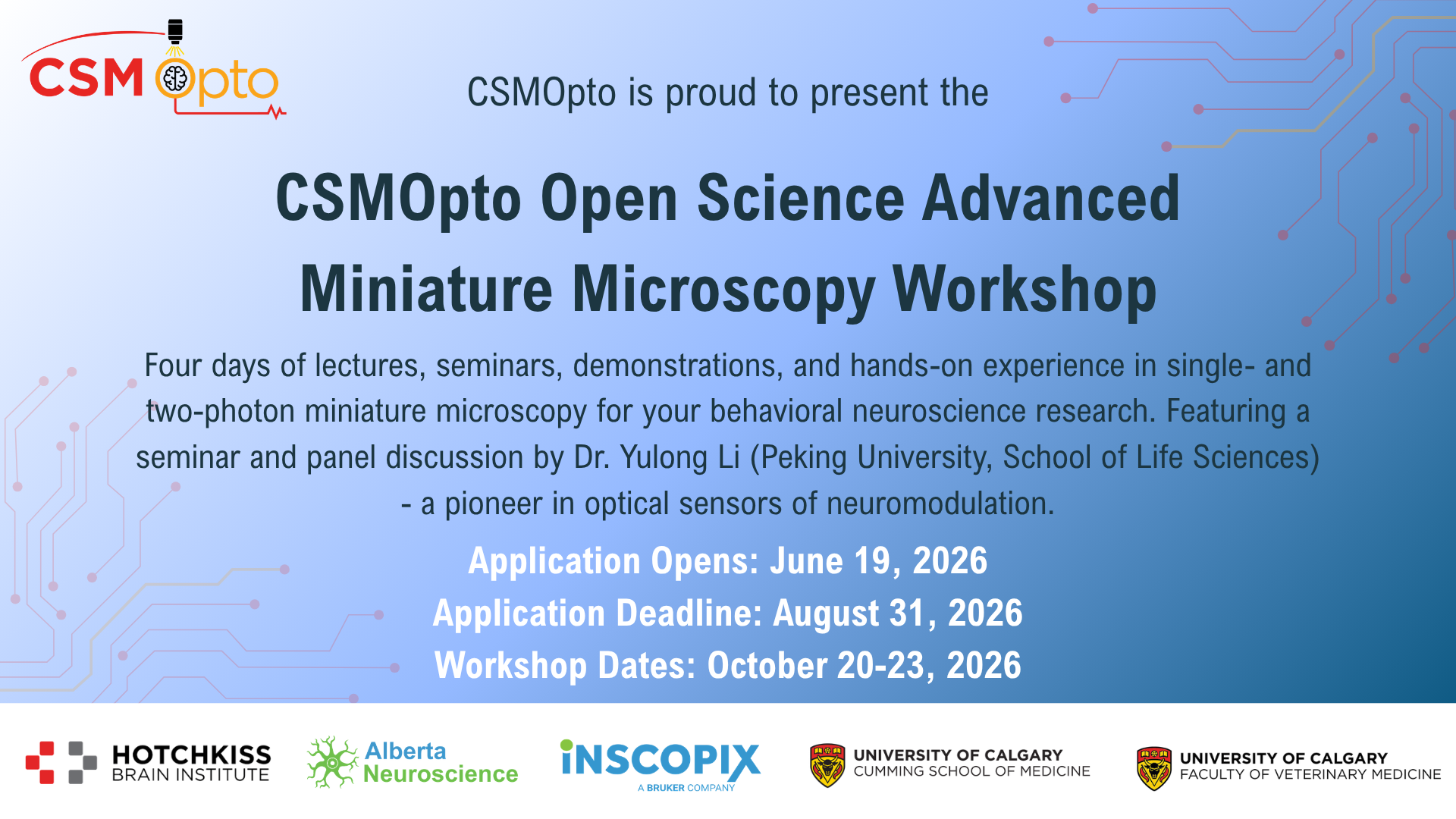
Alberta Neuroscience (ABNeuro), is proud to support the Cumming School of Medicine Optogenetics Core Facility (CSMOpto) at the University of Calgary in offering a workshop in the technique of Advanced Miniature Microscopy.
Overview
Miniature microscopy has addressed a long-standing challenge in neuroscience: recording the activity of specific brain cells in freely behaving animals. This technique enables visualization of individual cells with high spatiotemporal fidelity. However, its implementation has been hindered by technically challenging surgeries, difficult experiments, and complex data analysis.
To overcome these challenges and improve wide-spread adoption of miniature microscopy in biomedical and neuroscience research, the CSM Optogenetics Core Facility (CSMOpto) is offering an intensive workshop for neuroscientists interested in integrating this technique into their skill set. Our goal is to share our in-house expertise and resources with the broader Canadian neuroscience community to promote best practices in experimental design, technical execution, and data analysis.
The course emphasizes the core principles, technical foundations, and analysis frameworks that underpin this versatile technique. Participants will gain a structured understanding that supports customization for diverse research questions while helping to build a more unified approach across labs.
The program supports open science initiatives and aligns with the mission of the Hotchkiss Brain Institute (HBI) and the Tanenbaum Open Science Institute by fostering collaboration and knowledge sharing across Alberta and Canada.
The workshop will take place in person at the University of Calgary from October 20 to October 23, 2026. Content will include lectures, seminars, demonstrations, and hands-on work with topics including Introduction to Miniature Microscopy, Data Collection, Surgical Demonstrations, Experimental Demonstrations, Data Analysis, and Data Interpretation. There will also be a special Research Seminar presented by Dr. Yulong Li from Peking University-School of Life Sciences.
Workshop Content
The workshop will take place in person at the University of Calgary over four days. It will include lectures, seminars, demonstrations, and some hands-on work. Topics will include:
- Introduction to Miniature Microscopy
- Genetically encoded biosensors and optogenetic proteins
- Model systems and delivery methods
- General principles and limitations of miniature microscopy
- Miniature Microscopy Data Collection
- Basic concepts of data collection
- Pairing recordings with behavioural analyses
- Combinations with optogenetic stimulation
- Multi-site and multi-colour recordings
- Surgical Demonstrations
- GRIN lens implantation
- Imaging as a targeting aid
- Post-operative care
- Experimental Demonstrations
- Scruff-free animal handling training
- In vivo recording on neuronal activity in freely behaving mice
- Miniature Microscopy Data Analysis
- Data pre-processing
- ROI definition
- Data Interpretation
- Computational modeling
- Signal analysis
There will also be a special Research Seminar presented by Dr. Yulong Li from Peking University-School of Life Sciences.
Teaching Team
This workshop will be led by CSMOpto specialists, faculty at the University of Calgary, a representative from our industry partner Inscopix, Inc., and a special Research Seminar presented by Dr. Yulong Li from Peking University-School of Life Sciences. Dr. Li is a prominent professor at Peking University specializing in developing cutting-edge imaging probes to study neural communication, in vivo.
For more information on the CSMOpto team, please visit their website.
Workshop Application
Space in this Miniature Microscopy workshop is limited, so interested parties are required to submit an application to attend. Thanks to the support of Campus Alberta Neuroscience, the Tanenbaum Open Science Institute, Inscopix, Inc., the Department of Veterinary Medicine at University of Calgary, and the Hotchkiss Brain Institute, lodging and meals throughout the course are covered with the 500 CAD registration fee.
Key Dates
| Applications Open | June 19, 2026 |
|---|---|
| Application Deadline | August 31, 2026 at 11:59 PM MT |
| Notification of Decision | September 18, 2026 (subject to change) |
| Workshop Dates | October 20-23, 2026 |
Application Summary
- Academic:
- Master’s students, PhD students, or postdoctoral researchers engaged in neuroscience research with a significant emphasis on neural imaging
- Principal Investigators may apply, but trainees will be given priority
- Geographic:
- Applicants affiliated with a Canadian post-secondary institution will be given priority
Priority will be given to trainees and researchers from Alberta, but trainees outside Alberta are eligible to apply
- Applicants affiliated with a Canadian post-secondary institution will be given priority
- Additional considerations:
- Applicants should have a well-defined intention for applying the miniature microscopy technique to their research
- Applicants must be comfortable viewing animal surgery and handling rodents
- Proof of Institutional Animal Use Training approvals will be required
- Prior experience with any programming language is not required
Applications must be submitted electronically through an Online Application Submission. The individual who wishes to attend the workshop must be the one to apply.
It is imperative that the application is proofread before submission; changes to the application after the deadline are not allowed. Only a single copy of an application will be accepted. A list of application questions is provided in the Application Guidelines for reference only.
Applications must be submitted in completion before 11:59 PM MT on August 31th, 2025.
Late or incomplete applications will not be considered. It is the sole responsibility of the applicant to ensure the application submission adheres to all requirements and is submitted before the deadline.
Applications will be evaluated and ranked on the following criteria:
- Preference for Alberta-based applicants
- Preference for neuroscience trainees
- Qualifications and experience of the applicant
- Justification for attendance and benefit to applicant’s program of study or research project
- Benefit and contribution to supervisor’s program of neuroscience research
A maximum of 24 applicants will be invited to participate based on the review committee evaluations. CSMOpto and ABNeuro will not enter discussion on specific items in the review process or reasons for the rejection of applications. All decisions are final and cannot be appealed.
Successful applicants must accept their offer within five (5) business days of receiving the notification of decision from ABNeuro. An acceptance form will be provided and must be returned with supporting documentation to ABNeuro by email, signed by all relevant parties, within this time frame. Any potential conditions or required clarifications and their related timelines will be outlined with the offer. Failure to comply with this requirement may lead to withdrawal of the offer.
Successful applicants, on acceptance of their offer, will be registered for the four-day workshop. The registration fee includes the refreshments and lunch for the four workshop days, and for attendees from outside of Calgary, coverage for hotel accommodations.
Successful applicants who accept their offer are required to attend all four days of the workshop and provide feedback to workshop coordinators following the final day.
This workshop is made possible by support from:


CSMOpto
The Cumming School of Medicine Optogenetics Core Facility’s (CSMOpto) goal is to offer an array of equipment and facilities for the combined use of optogenetic stimulation, fiber photometry, and head-mounted miniscopes with behavioural testing in mice and rats. The facility staff offers expertise in rodent behavioural testing, optogenetics, stereotaxic surgery, data analysis, and technology development. CSMOpto also aims to foster educational development through comprehensive training, support, and teaching for our users. The facility is fully operational, and our most significant impact to date has been supporting the Cumming School of Medicine and Hotchkiss Brain Institute research excellence including several high-impact publications over the past 2 years. For more information, please visit their webpage.

ABNeuro
Alberta Neuroscience (ABNeuro), established in 2012 with support from the Government of Alberta, is a province-wide neuroscience network connecting the all post-secondary institutions across Alberta to increase the impact of neuroscience and mental health research, education and translation, developing the province as an epicenter for neuroscience excellence. Through collaborative partnerships with researchers, government and health system stakeholders, industry and community organizations, ABNeuro supports and accelerates innovative brain and mental health advances that improve brain health, patient care and quality of life in Alberta and beyond. For more information, please visit their webpage.

UCVM
The University of Calgary Faculty of Veterinary Medicine (UCVM) is a Canadian veterinary school located in Calgary, Alberta at the University of Calgary. The faculty was established in 2005 to meet Alberta’s need for highly skilled veterinary graduates to support rural Alberta, production animal and equine industries, animal and human health research, and public health. Before the establishment of the Faculty of Veterinary Medicine at the University of Calgary, the only veterinary school in western Canada was the Western College of Veterinary Medicine at the University of Saskatchewan. UCVM offers DVM & Graduate Programs, Advanced Clinical Training, Pathology & Diagnostic Services, and conducts research in animal and human health. For more information, please visit their webpage.

TOSI
The Tanenbaum Open Science Institute (TOSI) was founded to drive the adoption of Open Science across Canadian neuroscience research institutes. In addition to promoting Open Science within The Neuro, TOSI engages in strategic collaborations and partnerships through its Open Science Support and Partnership Framework. Through the Framework TOSI supports and guides other institutes in adopting Open Science practices and principles and establishes an alliance of neuroscience research institutes across Canada committed to Open Science. For more information, please visit their webpage.

Inscopix Inc.
Inscopix is empowering researchers in academia and industry with a pioneering neural circuit approach, to improve our understanding of the brain. For more information, please visit their webpage